What is lead nurturing?
The follow-up system that helps a buyer take the next reasonable step after first contact. Booking. Quoting. Reactivating. Whatever the next move is.

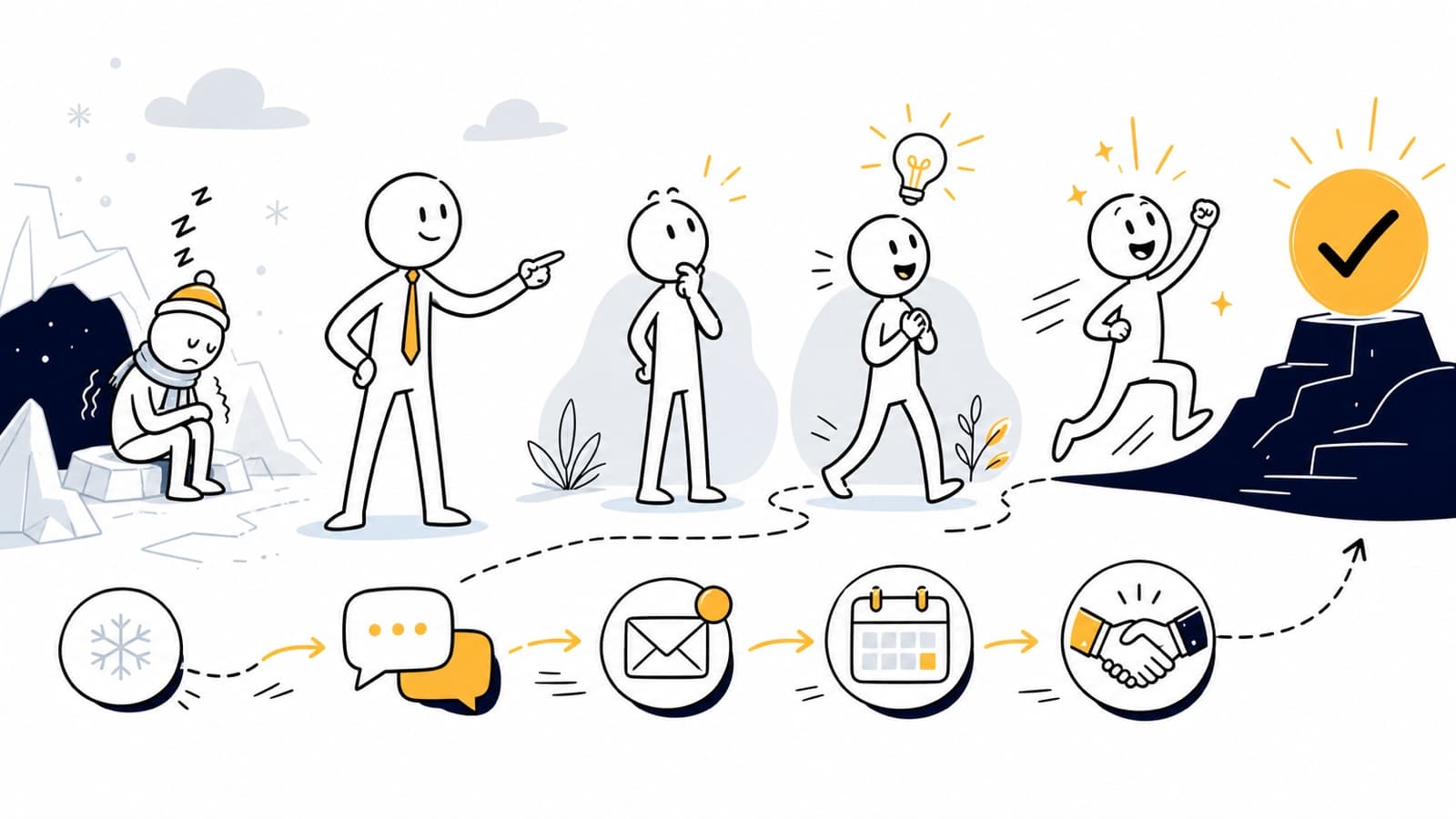
A practical framework for building follow-up systems that keep opportunities alive after first contact.
Bottom line
Lead nurturing is the follow-up system that helps a buyer take the next reasonable step after first contact. The best version is timely, specific, easy to respond to, and built around buyer intent instead of generic check-ins.
Need the right next step?
Take the 2-minute TechStack quiz and we’ll point you to the right fix before you browse partners.
Start DiagnosisLead nurturing isn't a newsletter problem. It's the operating system that keeps a real opportunity alive after the first touch. The best version is timely. Specific. And dead easy for the buyer to respond to. That's it.
Lead nurturing has one job. Help a person take the next reasonable step.
That step might be booking a call. Sending photos. Approving a quote. Picking a time. Confirming budget. Reading a guide. Reactivating after a delay.
Good nurturing doesn't blast the same message at everybody. It answers the question of where the buyer actually is in the decision.
Most businesses confuse nurturing with persistence though.
They send more reminders. More promos. More generic check-ins. That works for a short stretch. Then it trains people to ignore the business completely.
Useful nurturing is a different animal. It answers questions. Cuts uncertainty. Creates a clear next action. And gives the buyer a real reason to keep going.
For service businesses, this matters because leads almost never move in a straight line.
People compare providers. Ask a spouse. Read reviews. Wait for payday. Get distracted by their kid's soccer game.
If your follow-up depends on one employee remembering every thread, opportunities will fall through the floor.
I've watched a $14,000 remodel die because the salesperson kept a list of "warm leads" in a notebook on his desk. He went on vacation. The notebook stayed home. Three weeks later the customer signed with somebody else.
That's the leak.
The first mistake is treating every lead the same.
A person who calls about an urgent repair is not the same as somebody who downloaded a guide. A referral isn't a cold ad lead. A quote request isn't a newsletter sign-up.
The nurture path has to match the intent.
A simple model is enough. Hot leads have a current need and a clear path to booking or quote. Warm leads are interested but need education, timing, or trust. Cold leads aren't ready now but might be useful later. Old leads are past opportunities that could reactivate if the timing changes.
Once you group them, the message gets easier to write.
Hot leads need speed, clarity, and a human they can actually reach. Warm leads need proof, answers, and low-friction next steps. Cold leads need the occasional useful piece of content. Old leads need a real reason to re-open the conversation. Not a fake emergency.
The first response is the most important nurture message because it sets the tone.
It should confirm the inquiry. Show that a real next step exists. And make the buyer's job easier.
It doesn't need to be long. Shorter is usually better.
A strong first response has five pieces. Thanks. Context. Next step. Timing. And one easy question if you need it.
Example: "Thanks for reaching out about the AC issue. We handle repair calls in your area. Next step is a quick call so we can confirm the problem and book a time. Are you looking for service today or later this week?"
Notice what's missing. No vague promises. No wall of text. No 10-question interrogation. No pressure.
The message respects the buyer's intent and pushes the process forward. That's the whole job.
Most buyers don't respond to one message. That doesn't mean you should chase them forever.
It means the follow-up sequence needs a real structure.
A practical sequence might be: an immediate confirmation, a same-day follow-up, a next-day reminder, a useful proof or FAQ message, and a final polite close-the-loop message.
Each touch should have a job.
One confirms. One clarifies. One offers proof. One removes friction. One asks if the buyer still wants help.
If every message just says "just checking in," the sequence is dead weight. Buyers can smell it from a mile away.
Channel matters too. Phone, SMS, email, and voicemail each have a place. Use the channel the buyer started with when you can. Ask permission where the law requires it. Keep compliance in mind for SMS and email or you'll buy yourself a different kind of problem.
Good nurturing should feel helpful. Not invasive.
The best nurture copy is plain.
It uses the buyer's words. References the actual need. Gives one clear action. Don't write like a software company when your buyer needs a plumber, dentist, roofer, accountant, or med spa.
Specific beats clever every time.
A useful follow-up might say: "We still have your request for a roof inspection in Westerville. If you want, reply with the best day this week and we'll send two appointment windows."
That's better than: "We are circling back to see if you are ready to optimize your property improvement journey."
One of those sounds like a person. The other sounds like a bot wearing a suit.
Good messages also handle objections before they turn into silence.
If price is usually the issue, send a short note about what affects pricing. If timing is the issue, show open windows. If trust is the issue, send one relevant review or short case note. If complexity is the issue, explain the process in three plain steps.
Don't make the buyer ask. Most won't. They'll just ghost.
Lead nurturing should be measured like operations. Not vibes.
Track time to first response. Contact rate. Appointment rate. Quote rate. Close rate. No-show rate. Reactivation rate.
Also track where leads stall. If lots of people book but don't show, your first response isn't the problem. If lots of people request quotes but never reply, the problem might be qualification or the timing of your follow-up.
Review by source too. Ad leads, referrals, organic search, partner referrals, and returning customers all behave differently. A single blended conversion rate hides the truth.
If one source produces slower-moving leads, it needs education. If another produces urgent calls, it needs speed and routing. Lumping them together gives you an average that means nothing.
Keep the system simple enough that the team will actually use it. A perfect 14-step nurture map that nobody maintains is worse than a clean five-step process with clear ownership.
Start with one lead type. Map the current path from inquiry to outcome. Write the first response. Write three follow-ups. Decide when a human steps in. Decide when the lead is closed, paused, or moved into long-term nurture.
Then test it for two weeks.
Don't automate what you don't understand yet.
First, listen to calls. Read messages. Find the real reasons leads stall. Then automate the parts that are repetitive and measurable. Keep humans close to the moments where judgment, empathy, or negotiation matter.
Those are the moments where the deal actually closes.
Lead nurturing works when it protects intent. The goal isn't to pressure people into buying. The goal is to make sure good opportunities don't die because the business was unclear, slow, generic, or disorganized.
That's the difference between a follow-up system and a "checking in" graveyard.
TechStack Founder
Corné van Willigen writes from TechStack's operator perspective, focusing on the systems where local demand turns into booked work or disappears.
Direct-Response Marketing Strategist
Perry Belcher contributes direct-response strategy around buyer intent, offer clarity, trust signals, and conversion-focused messaging.
Reviewed for clarity, search intent, and operational usefulness by TechStack.
Last reviewed
Google Search Central
Google Search Central
Questions
The follow-up system that helps a buyer take the next reasonable step after first contact. Booking. Quoting. Reactivating. Whatever the next move is.
Enough to clarify, give proof, remove friction, and close the loop. The exact number depends on urgency and buyer intent. A roof leak is not a newsletter subscriber.
It references the real request. Gives one clear next step. And sounds like a person who knows the business. Not a generic automation pretending to care.
At the first missed or delayed response point. Fix speed, context, and ownership before you add long automation sequences. Otherwise you're scaling the same broken process.
Next move
Start the quiz to surface the real leak and get routed toward the most relevant partner path.
Plain-English notes on missed calls, faster follow-up, reviews, AI answering, and small fixes that help service businesses book more jobs.